Center-based DIR/Floortime therapy
A space designed for your child
Therapy happens in a welcoming, well-equipped environment built for exploration. Our centers offer specialized sensory support to help your child feel regulated, focused, and ready to reach their next developmental milestone.









A place built for connection
A sensory-rich environment
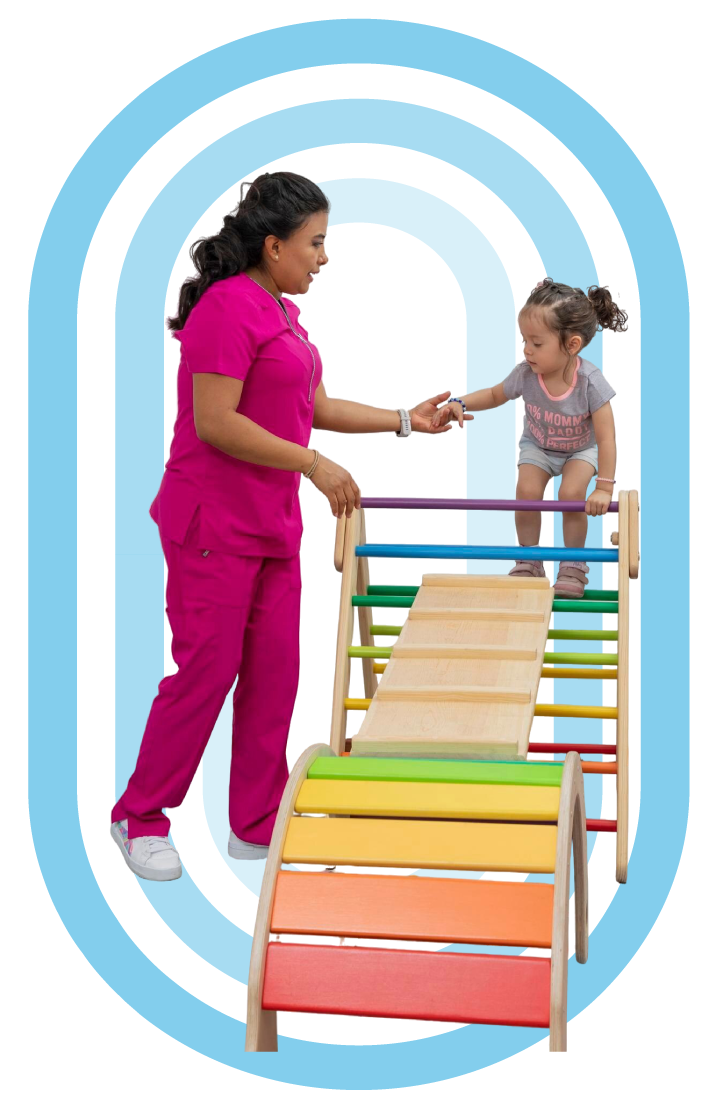
Our centers are designed with your child in mind. Swings for vestibular input. Climbing structures for proprioceptive feedback. Quiet spaces for regulation. Engaging materials that invite exploration and play.
Everything your child needs in one place
No need to piece together different therapies at different locations. Our centers provide a comprehensive environment where your child can work on communication, regulation, social skills, and development—all through play.
Therapists who follow their lead
Your child's DIR therapist meets them where they are. If they're drawn to the sensory table, that's where connection begins. If they need movement, the therapist follows. Play unfolds naturally, not according to a rigid agenda.
Small group opportunities
When appropriate, your child can participate in small playgroups with peers. They practice social skills in a supportive setting with therapists facilitating connection and communication.
You're welcome to stay and learn
You can observe sessions, participate when it feels right, or use the time for yourself. Many parents stay initially to watch strategies in action, then feel comfortable stepping away as their child settles in.
When structure supports growth
For some children, home has too many distractions. For others, school feels overwhelming. A center offers something different—a dedicated space for learning that’s neither home nor school.
- Specialized equipment that homes don't have - Therapeutic swings. Climbing walls. Ball pits. Sensory rooms. Equipment designed specifically to support regulation, motor development, and exploration.
- A neutral space for focus - At home, your child might associate certain rooms with certain activities. At our center, this space exists only for play, exploration, and connection. That clarity helps some children focus.
- Peer interaction in a controlled setting - Your child can practice social skills with other children in an environment where therapists are present to support, facilitate, and guide interactions.
- Consistency and routine - Your child comes to the same welcoming space at the same time each week. The predictability helps them feel safe. The routine helps them know what to expect.

The shifts parents notice

Your child walks into the center willingly—even eagerly

They stay engaged in play for longer periods

Regulation improves in structured environments

They start seeking out other children during playgroups

Communication emerges through playful interaction

They generalize skills learned at the center to home and school
Development through play and exploration
Your child works on the same goals as home or school-based therapy—but with access to specialized equipment and environments:

Sensory regulation
and body awareness
Using swings, climbing structures, and sensory materials to help your child understand their body, regulate their arousal level, and feel grounded enough to connect.
Communication
through interactive
play
Building back-and-forth interaction through bubbles, parachute games, obstacle courses, pretend play. Your child learns to communicate because play makes them want to.
Motor planning
and coordination
Navigating obstacle courses. Climbing. Jumping. Balancing. Motor skills develop through fun, challenging activities that feel like play—not drills.
Social skills
in small groups
When ready, your child joins small playgroups. They practice turn-taking, sharing space, reading social cues, and building friendships with therapist support.
Emotional
regulation tools
Learning to recognize when they’re overwhelmed and what helps. Quiet corners for calming. Movement activities for releasing energy. Co-regulation with therapists who understand.
Problem-solving
and flexible thinking
What happens when the tower falls? How do we build this differently? Can we figure out a new way? Cognitive flexibility grows through playful challenges.

All of it happens in a space designed specifically for exploration, connection, and growth.
Trusted in Classrooms Across New Jersey


We’d been doing home-based therapy for two years. It was good, but something was missing. The moment my son saw the climbing wall at Dream DIR, something clicked. He’s regulated, he’s engaged, and he actually asks to go. We didn’t know a space could make that much difference.
That’s how I know it’s working. My daughter used to resist every session. Now she’s pulling me toward the car. The therapists follow her lead completely — no forcing, no rigid structure. Just real connection through play.
We spent years thinking our son’s need to climb and crash was something to manage. Dream DIR saw it differently from day one. It wasn’t a problem — it was how he regulated. Building therapy around that changed everything.
The sensory room, the swings, the playgroups — it’s all designed in a way that feels natural, not clinical. My daughter is building friendships, communicating more, and genuinely happy when she’s there. As a parent, that means the world.
Before Dream DIR, we were driving to three different locations for different therapies. Now everything happens at the center — and the team actually talks to each other. The consistency has made a huge difference in how our son is progressing.
Every therapy before this was a battle — getting him in the car, through the door, into the room. At Dream DIR, he walked in and never looked back. The team didn’t just work with him; they genuinely got him. Watching him thrive in a place he actually loves has given our whole family something we didn’t realize we’d lost — hope.
How we're different at our centers
"Sit still and pay attention first, then we can play."
Movement is regulation for many children. We use play and movement as the foundation for learning—not a reward after compliance.
"You need to earn access to preferred activities."
We don't withhold connection or play as leverage. We meet your child where they are and build from their interests.
"Your child needs to stay in this room for the full session."
If your child needs to move between spaces, we follow. If they need quiet, we go to the sensory room. We adapt to their needs, not force them into ours.
"This is taking too long. They should be further along by now."
Every child develops at their own pace. We celebrate the progress they're making, not measure them against arbitrary timelines.
"Parents aren't allowed in the therapy room—it's too distracting."
Every child grows at their own pace. We celebrate the progress your child is making, not compare them to developmental checklists.
"Behaviors need to be eliminated before real learning can happen."
Behaviors are communication. We address the underlying need—for regulation, connection, sensory input—not just suppress the behavior.
Simple steps to a welcoming space
You reach out
Call 973-899-8556 or fill out our contact form. We discuss your child’s needs, verify your New Jersey insurance, and explain what center-based DIR therapy looks like.
Visit our center
We invite you and your child to tour the center. Your child can explore the space. You can meet therapists, ask questions, and see if the environment feels right for your family.
Initial evaluation
A DIR therapist conducts a comprehensive evaluation at the center. We observe how your child explores, engages, and regulates in this new environment.
We create a personalized plan
We develop an individualized plan based on your child’s unique sensory profile, developmental level, and your family’s goals. No templates—just a plan for your child.
We handle insurance authorization
We submit everything to your insurance and manage the paperwork. All NJ Medicaid plans and most commercial insurance cover center-based DIR/Floortime therapy.
Therapy begins
Your child starts regular sessions at our center. Connection deepens. Skills emerge. Progress gets tracked, and we adjust strategies as your child grows.

Ethan's story: When movement found purpose
The beginning
When Ethan’s parents called Dream DIR, home-based therapy wasn’t working. Ethan, age 5, needed constant movement. He’d climb furniture, crash into walls, run in circles. At home, there wasn’t enough space or equipment to channel that need.
“He was seeking something we couldn’t provide at home,” his dad said. “We needed more.”
The plan
Our DIR therapist, Michael, evaluated Ethan at our center. He immediately saw Ethan’s face light up at the climbing wall. The swings. The ball pit. Ethan wasn’t being “difficult”—he was seeking sensory input.
Michael built a plan around Ethan’s sensory needs:
- Use movement activities as the foundation for connection
- Create obstacle courses that required communication to complete
- Introduce peers gradually during movement-based play
- Help Ethan learn to regulate through his body
The work
Ethan came to the center three times a week. Michael met him at the climbing wall. Instead of asking Ethan to sit and focus, Michael climbed with him. They created games. They built challenges together.
When Ethan was regulated through movement, he became available for connection. He started making eye contact. Responding to prompts. Even using words to request “more jumping.”
The results
After two months: Ethan was staying engaged for full 45-minute sessions. He was using 2-3 word phrases to communicate during play.
After four months: Ethan joined a small playgroup. He took turns on the swing. He helped another child complete the obstacle course. He laughed when they succeeded together.
After six months: Ethan’s parents reported he was calmer at home. He could regulate himself better. He asked to go to “Michael’s place” every week.
“The center gave him what home couldn’t,” his mom said. “Space to move, equipment to explore, and a therapist who understood that movement wasn’t the problem—it was the solution.”
The beginning
When Ethan’s parents called Dream DIR, home-based therapy wasn’t working. Ethan, age 5, needed constant movement. He’d climb furniture, crash into walls, run in circles. At home, there wasn’t enough space or equipment to channel that need.
“He was seeking something we couldn’t provide at home,” his dad said. “We needed more.”
The plan
Our DIR therapist, Michael, evaluated Ethan at our center. He immediately saw Ethan’s face light up at the climbing wall. The swings. The ball pit. Ethan wasn’t being “difficult”—he was seeking sensory input.
Michael built a plan around Ethan’s sensory needs:
- Use movement activities as the foundation for connection
- Create obstacle courses that required communication to complete
- Introduce peers gradually during movement-based play
- Help Ethan learn to regulate through his body
The work
Ethan came to the center three times a week. Michael met him at the climbing wall. Instead of asking Ethan to sit and focus, Michael climbed with him. They created games. They built challenges together.
When Ethan was regulated through movement, he became available for connection. He started making eye contact. Responding to prompts. Even using words to request “more jumping.”
The results
After two months: Ethan was staying engaged for full 45-minute sessions. He was using 2-3 word phrases to communicate during play.
After four months: Ethan joined a small playgroup. He took turns on the swing. He helped another child complete the obstacle course. He laughed when they succeeded together.
After six months: Ethan’s parents reported he was calmer at home. He could regulate himself better. He asked to go to “Michael’s place” every week.
“The center gave him what home couldn’t,” his mom said. “Space to move, equipment to explore, and a therapist who understood that movement wasn’t the problem—it was the solution.”
Welcoming spaces across the state
Dream DIR operates centers designed specifically for DIR/Floortime therapy throughout New Jersey. Each center offers:
North Jersey:
- Bergen County
- Passaic County
- Essex County
- Morris County
- Hudson County
- Sussex County
- Warren County
Central Jersey:
- Union County
- Middlesex County
- Somerset County
- Hunterdon County
- Mercer County
- Monmouth County
South Jersey:
- Ocean County
- Burlington County
- Camden County
- Gloucester County
- Salem County
- Cumberland County
- Cape May County
- Atlantic County
Whether you’re in North, Central, or South Jersey—we have a center designed for your child’s growth.
Questions New Jersey families are asking
How is center-based therapy different from home-based?
Centers offer specialized equipment and environments designed specifically for sensory and motor development. Some children focus better in a dedicated therapy space separate from home.
Can I stay and watch sessions?
Yes. Many parents observe, especially initially. You can watch through observation windows, sit in the room, or step away—whatever works for your family.
Will my child be in a room alone with the therapist?
Most sessions are one-on-one, but when appropriate, your child can join small playgroups with peers for social skill development.
How many hours per week will my child need?
Most children receive 5-15 hours weekly, depending on their needs and insurance authorization. Your supervising therapist recommends specific hours.
Does insurance cover center-based DIR therapy?
Yes. New Jersey law requires Medicaid and most commercial insurance to cover DIR/Floortime at qualified centers. We verify your benefits upfront.
What if my child has trouble with transitions or new environments?
We go slow. We let your child explore at their own pace. We don’t force participation. Many children who struggle with transitions do well once they realize the center is a safe, fun place.
Can we switch between home-based and center-based therapy?
Yes. Some families use both—center sessions for specialized equipment and peer interaction, home sessions for daily routine support. We customize based on your needs.
Will the same therapist work with my child every time?
Yes. Consistency is essential for building trust and connection. Your child works with the same DIR therapist each session.
What if my child refuses to participate in activities?
We follow their lead. If they want to sit and watch, we sit with them. If they want to explore alone, we stay nearby. Connection can’t be forced—we build it gradually.
How do I know if center-based therapy is right for my child?
Tour our center. Watch your child explore. See how they respond to the environment. We’ll help you determine if center-based, home-based, or a combination is best.
A space waiting for your child
Dream DIR’s centers are designed for one thing: helping your child discover connection, regulation, and joy through play. Come see the space. Meet our therapists. Watch your child explore.
Every dream begins with one small step. Let’s take it together.